7 Steps to Implement Sustainable Corporate Travel Policies
Quick answer
Implement a sustainable corporate travel policy by reviewing current travel, setting measurable goals, defining when trips are necessary, establishing booking guidelines, evaluating suppliers, tracking travel activity and estimated emissions, and reviewing results regularly. Consider business needs, traveler safety, accessibility, cost, and transportation options. Support environmental claims with documented data rather than assuming a particular vehicle or service is automatically more sustainable.
A sustainable corporate travel policy gives employees clear instructions for deciding when to travel, choosing transportation, obtaining approval, and recording the trip. It should support business needs while providing a consistent way to evaluate cost, traveler requirements, and environmental impact.
Start with the journeys your company actually makes. A small business arranging occasional airport transfers needs a different process from a company coordinating weekly flights, conferences, and multi-stop roadshows.
This seven-step guide explains how to build a practical policy, introduce it to travelers, and review the results.
Table of Contents
- Step 1: Review Current Travel and Establish a Baseline
- Step 2: Write a Practical Corporate Travel Policy
- Step 3: Set Goals and Evaluate Travel Options
- Step 4: Plan Ground Transportation Around the Complete Trip
- Step 5: Document Your Emissions Reporting Method
- Step 6: Set Up Booking, Approval, and Exception Procedures
- Step 7: Train Travelers, Test the Policy, and Review Results
Step 1: Review Current Travel and Establish a Baseline
Collect travel records before setting reduction targets. Review a full year when available so conferences, seasonal activity, and recurring business trips are represented. A newer company can begin with a shorter period and explain that limitation.
Compare booking records with expense reports and supplier invoices. Remove duplicate entries and identify canceled trips, refunds, and bookings made outside the usual channel.
Record information such as:
- Trip purpose and business owner
- Travel dates, origin, destination, and transportation mode
- Number of travelers and vehicles
- Available distance, vehicle, or flight details
- Hotel nights
- Transportation and lodging expenditure
- Missing information and the source of each record
Keep financial and environmental measures separate. A lower fare does not establish lower emissions, and reduced spending does not necessarily mean fewer journeys.
Assign someone to maintain the records and resolve missing information. A manageable process that is completed regularly is more useful than a detailed template nobody maintains.
Step 2: Write a Practical Corporate Travel Policy
Make the policy specific enough that an employee can follow it without asking a manager to interpret every sentence.
Include these seven sections:
- Purpose and scope: identify the employees, business units, and trip types covered.
- Travel decisions: explain when a virtual meeting or combined visit should be considered.
- Approval responsibilities: name the approver, backup contact, and any spending thresholds.
- Booking requirements: specify approved channels and the information required.
- Supplier selection: describe how safety, accessibility, suitability, price, and environmental information are evaluated.
- Travel records: identify who submits receipts and activity details.
- Exceptions and review: explain how urgent changes are approved and when the policy is updated.
Separate requirements from preferences. “Use the approved booking channel unless an exception is authorized” is a requirement. “Consider sharing transportation with colleagues attending the same meeting” is a planning preference that still depends on timing and passenger needs.
For executive visits and roadshows, our corporate transportation planning guide explains the itinerary and contact details needed to coordinate a business trip.
Step 3: Set Goals and Evaluate Travel Options
Choose goals that match your available information and business responsibilities.
Initial goals might focus on completing travel records, reviewing recurring journeys, or increasing the proportion of bookings made through an approved channel. Introduce an emissions reduction target after establishing a documented baseline and calculation method.
For each proposed trip, ask:
- Does the business objective require an in-person visit?
- Can several appointments be combined into one journey?
- Are there practical rail, public transportation, or shared-transfer options?
- How do the complete door-to-door schedules compare?
- What accessibility, security, luggage, or working-hour requirements apply?
- What information supports the environmental comparison?
Avoid making every choice automatic. A nonstop flight, a nearby hotel, or a shared vehicle may offer practical advantages, but the environmental outcome needs a suitable comparison.
When reviewing another organization’s policy, borrow useful structure rather than copying targets or approval rules that do not fit your company.
Step 4: Plan Ground Transportation Around the Complete Trip
Ground transportation decisions should account for passengers, belongings, destinations, and timing together.
Two colleagues arriving at the same airport may be able to share a transfer when they are ready at similar times and have compatible destinations. Travelers arriving hours apart or attending separate meetings may need different arrangements.
Consolidating passengers can reduce the number of booked vehicles, but fewer vehicles alone does not establish an emissions saving. Consider the actual vehicles, routes, occupancy, and any additional travel required.
Match capacity to the actual load
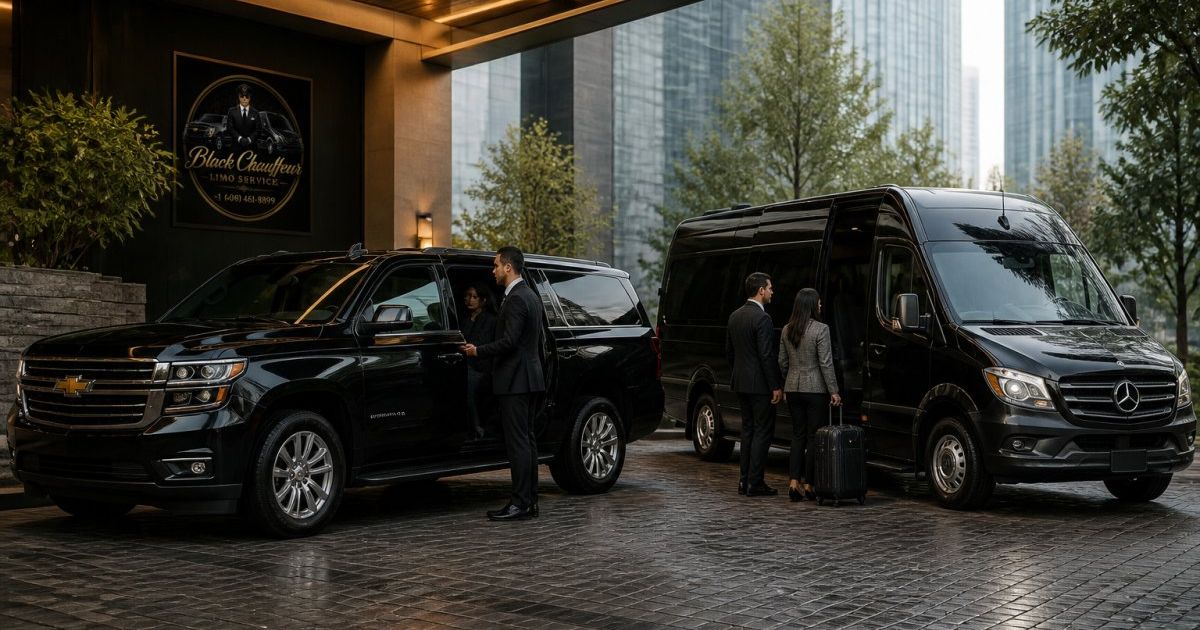
Black Chauffeur Limo Service offers these passenger configurations:
- Lincoln Aviator: up to 3 passengers
- Chevrolet Suburban LT: up to 6 passengers
- Mercedes-Benz Sprinter: configurations for 6, 7–10, or 11–14 passengers
Confirm luggage and equipment separately. Maximum seating does not guarantee space for every suitcase, presentation case, mobility item, or other belonging.
Review our SUV and Sprinter vehicle options before requesting an assignment. If a particular vehicle type or feature is required, ask for written confirmation of availability.
Coordinate airports and meeting stops
For SFO, SJC, OAK, or MRY journeys, provide flight details, passenger contacts, luggage, and the actual destination entrance. Private aviation requests also need the receiving FBO and its confirmed meeting location.
Our airport transfer planning resources help distinguish airline-terminal pickups from private-operator arrangements.
For roadshows, include each office entrance, appointment deadline, expected stop duration, and final return. Avoid assuming that one vehicle remains suitable when the team separates or the passenger count changes.
Step 5: Document Your Emissions Reporting Method
Use a defined method rather than treating a booking total as an emissions measurement.
The
GHG Protocol business travel guidance covers employee business transportation provided by third parties under Scope 3, Category 6. Hotel stays are optional within that category. Company-controlled vehicle energy use and employee commuting have different classifications.
Calculation methods can use fuel, distance, or expenditure data. Match activity units to the selected factor: vehicle distance and passenger distance are different measures.
The
EPA GHG Emission Factors Hub provides published factors for organizational reporting. Record the source, version, units, and assumptions used.
Create a repeatable reporting record
For each entry, retain:
- Reporting period and trip reference
- Travel activity and its source
- Calculation method
- Factor and version
- Estimated emissions and reporting unit
- Missing information or limitations
- Person responsible for review
Do not label a calculated result as directly measured emissions. Identify estimates and explain how missing records are handled.
Report both total activity and useful comparison measures. A growing company can reduce emissions per trip while increasing total emissions because it travels more. Present both figures when relevant.
If the method changes, explain the change before comparing results with earlier periods. Have the person responsible for your company’s greenhouse gas inventory review the approach before using it in formal reporting.
Step 6: Set Up Booking, Approval, and Exception Procedures
Make the approved process easy to find and complete. A shared request form may be sufficient for a small company; a larger program may use a travel platform.
Collect the same essential details regardless of the tool:
- Business purpose and traveler names
- Proposed dates and itinerary
- Transportation and accommodation requirements
- Cost estimate
- Options considered
- Approver and decision deadline
- Reason for any exception
Configure automated rules only where the booking system supports them. Otherwise, assign a manual review and make that responsibility clear.
Create practical exception categories
Examples include accessibility requirements, a documented safety concern, an urgent client request, a disrupted flight, or the absence of a workable alternative.
Name an approver and backup for each category. Set an escalation process for time-sensitive situations and ask travelers to record emergency changes afterward when advance approval is impractical.
Compare complete transportation quotes
Use the same itinerary when comparing suppliers. Include the vehicle, service period, waiting, stops, applicable charges, and cancellation conditions.
Our chauffeur pricing guides provide planning information, while the accepted quote establishes the trip-specific price. Review the reservation terms and conditions before approving the booking.
A supplier’s environmental statement should describe what is being claimed and what supports it. Do not assume that a luxury label, a vehicle photograph, or the availability of group transportation establishes an environmental benefit.
Step 7: Train Travelers, Test the Policy, and Review Results
Start with a short pilot involving the employees who regularly arrange travel. Ask them to test the request form, approval process, supplier instructions, and expense submission.
Explain four points during training:
- How to decide whether a trip is needed
- Where and how to book
- Who approves exceptions and urgent changes
- What records must be submitted afterward
Review the pilot before applying the policy across the company. Remove unnecessary steps and clarify rules that repeatedly cause confusion.
A quarterly review can examine booking compliance, missing records, exception patterns, expenditure, travel activity, and estimated emissions. Include traveler feedback about accessibility, fatigue, scheduling, and practical alternatives.
Change rules when the evidence supports a change. There is no need to alter a policy every quarter simply to meet a schedule.
Arrange the ground transportation for approved trips
Black Chauffeur Limo Service provides pre-arranged airport transfers, executive transportation, and group roadshow service across Silicon Valley and the Bay Area.
Send the passenger count, luggage, exact addresses, flight or FBO details, meeting stops, and required service period. If your company needs trip information for environmental reporting, ask what records are available before assuming a particular data format or emissions report can be supplied.
Reserve 12–24 hours ahead whenever possible, and earlier for larger groups or complex itineraries. For a pickup less than 12 hours away, call +1 (408) 461-8899 directly; service depends on vehicle and chauffeur availability.
Use our business transportation reservation page, or text or WhatsApp +1 (408) 394-3575 to discuss the itinerary. A request or preliminary quote becomes a secured reservation after the company accepts it and provides confirmation.
How can you plan your chauffeur transportation?
Frequently asked questions
- How do you implement a sustainable corporate travel policy?
- Review existing travel, establish a baseline, assign responsibilities, and write clear booking and approval rules. Evaluate practical alternatives, document your emissions reporting method, and create an exception process. Test the policy with regular travelers, explain how to follow it, and review costs, travel activity, estimated emissions, and employee feedback.
- What should a sustainable business travel policy include?
- Include the policy’s scope, criteria for necessary travel, approval responsibilities, booking channels, supplier selection requirements, and travel-record obligations. Address traveler safety, accessibility, cost, transportation suitability, and environmental information. Explain how urgent changes and exceptions are handled, who maintains the policy, and when results are reviewed.
- How can companies reduce emissions from business travel?
- Consider replacing suitable trips with virtual meetings, combining appointments, and comparing practical transportation options. Shared transfers may suit travelers with compatible schedules and destinations. Evaluate the complete journey using documented information rather than assuming a particular mode or vehicle is always better. Track total estimated emissions alongside travel activity to assess results.
- How do you encourage employees to follow a sustainable travel policy?
- Make the booking process straightforward, explain the reasons for the rules, and provide examples relevant to employees’ actual trips. Name approvers and backup contacts, allow documented exceptions, and offer short training. Review recurring difficulties with travelers and adjust impractical requirements while keeping responsibilities and reporting expectations clear.