Corporate Roadshow Transportation: Planning Guide
Quick answer
To plan corporate roadshow transportation, share the full meeting itinerary, passenger and luggage counts, pickup locations, and a contact for schedule changes. Choose a vehicle that fits the group, allow time between stops, and confirm how the chauffeur will coordinate each pickup.
Table of Contents
- What Corporate Roadshow Transportation Involves
- Roadshow Itinerary Planning and Logistics
- Executive Roadshow Logistics Across Multiple Stops
- Multi-Stop Chauffeur Service Coordination
- Private Aviation Ground Transportation for Roadshows
- Fleet Selection and Vehicle Capacity Planning
- Booking and Contingency Planning
- Frequently Asked Questions
Last Updated: September 23, 2026
What Corporate Roadshow Transportation Involves
Corporate roadshow transportation coordinates executives, investors, and support staff across multiple locations in a single business event. Unlike a single airport transfer, a roadshow orchestrates vehicles, timing, and logistics across several stops, hotel pickups, office visits, investor meetings, airport departures, often within tight windows.
A typical roadshow moves a leadership team from the airport to a hotel, then to three investor meetings across different neighborhoods, back to the airport, and repeats in a new city the next day. Each leg requires a professional chauffeur, the right vehicle for passenger count and luggage, real-time coordination, and contingency plans for delays.
Complexity grows with group size. A single executive needs one vehicle; ten people across multiple vehicles require dispatch coordination, driver communication, and a clear itinerary. Black Chauffeur Limo Service matches vehicle capacity to passenger count, monitors flight arrivals, and adjusts pickup times in real time.
Roadshow Itinerary Planning and Logistics
Your itinerary should include:
- Passenger names and count at each stop
- Pickup and drop-off addresses with entrance details
- Estimated duration at each location
- Contact person and phone number for each stop
- Flight times and airport terminal information
- Luggage count and special equipment needs
- Any VIP or confidentiality requirements
Share this itinerary with your transportation provider so they can assign the right vehicles, brief drivers on timing, and identify bottlenecks.
Real-time adjustments happen constantly: meetings run over, flights delay, venues change. Your transportation partner should have a single point of contact who relays changes to drivers immediately, not via email, but through dispatch systems.
McKinsey's research on [executive travel logistics(/blog/corporate-executive-travel-logistics-guide) | mckinsey.com] emphasizes that coordination failures in multi-stop transportation are among the top causes of executive schedule delays. The fix is simple: one person owns the itinerary, one person owns the transportation coordination, and they talk directly.
Executive Roadshow Logistics Across Multiple Stops
Moving an executive team across multiple cities demands precision. Each city has different traffic patterns, airport procedures, and meeting venues.
Map realistic travel time between stops, accounting for traffic, parking, and walking time. A roadshow scheduling a 9 AM meeting then a 10 AM meeting across town fails before it starts.
Coordinate with each venue: verify designated drop-offs, specific entrances, parking restrictions, security checkpoints, and access procedures so drivers know exactly where to go.
Manage passenger flow: decide whether all executives travel together or depart separately, and whether luggage stays in one vehicle or travels with each group.
Black Chauffeur Limo Service assigns a dedicated point of contact who manages the entire roadshow schedule, vehicle assignments, driver legs, and contingencies.
Multi-Stop Chauffeur Service Coordination
When passenger count exceeds what a single vehicle can handle, multi-vehicle coordination becomes critical.
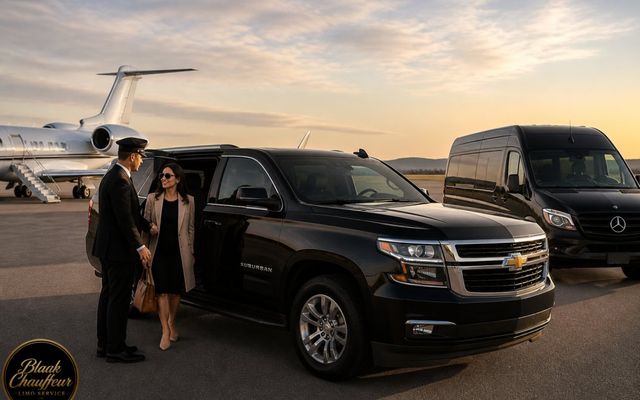
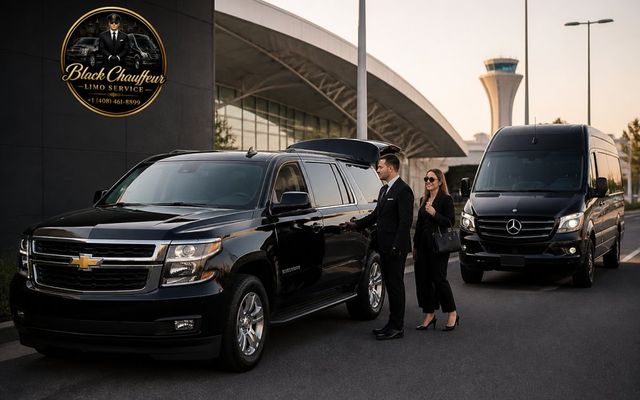
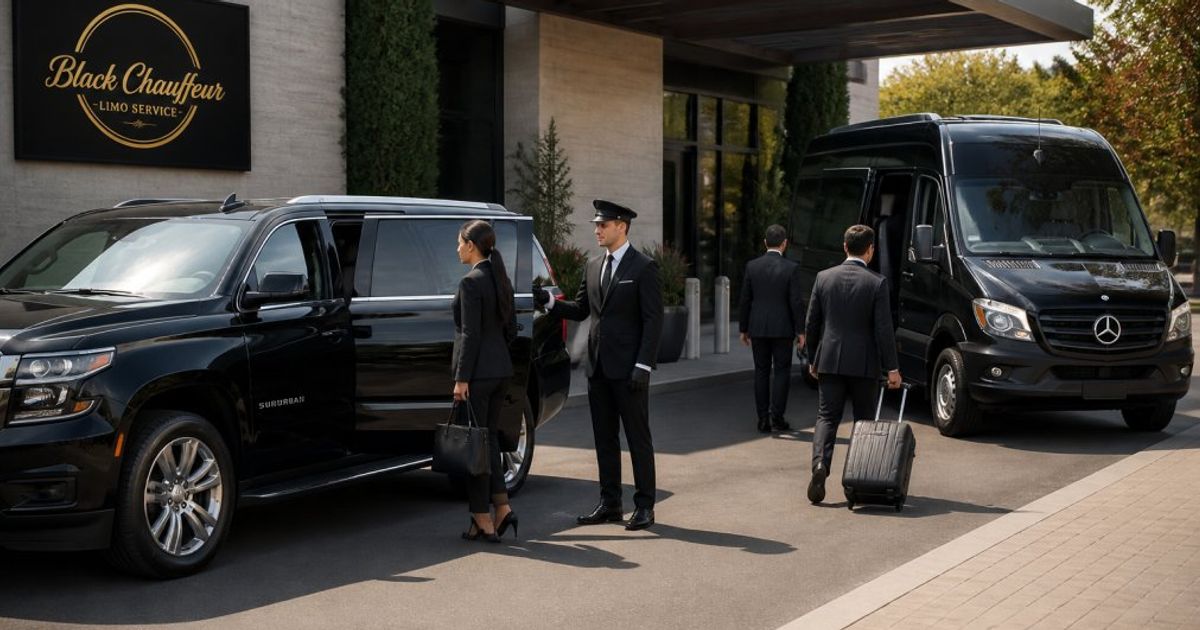
A Mercedes-Benz Sprinter Group Transportation carries 11-14 passengers; a Chevrolet Suburban SUV Chauffeur Service handles up to 7. A roadshow moving fifteen people needs two vehicles arriving simultaneously and departing on schedule.
This requires:
- Driver communication: Both drivers need to know the itinerary, the timing, and where to meet
- Passenger manifest: Which passengers ride in which vehicle? Does this change between legs?
- Luggage coordination: Does luggage travel with each vehicle, or does one vehicle handle all bags?
- Contingency assignments: If one driver calls in sick, which remaining driver takes which vehicle and passengers?
A common mistake: assigning drivers independently so they arrive at different times and don't know the full itinerary.
The right approach: one transportation partner manages all vehicles, assigns and briefs all drivers on the complete itinerary, and maintains real-time communication. If a meeting runs long or a flight delays, both drivers know and adjust.
Private Aviation Ground Transportation for Roadshows
Many executive roadshows involve private aviation, either executives travel from a private terminal or the roadshow visits investor offices near private airfields.
Private aviation ground transportation differs from commercial transfers. Private flights land at FBO (Fixed Base Operator) facilities like Signature Aviation at SJC or SFO, or Atlantic Aviation at SJC, which have different access procedures, pickup points, timing windows, and security protocols.
How FBO Notification Works
When a private aircraft lands, the crew notifies the FBO of deplaning time. The FBO does not automatically notify your transportation provider, so you must establish a notification protocol in advance.
Provide your transportation partner with the aircraft tail number, expected landing time, and FBO facility. Your partner contacts the FBO to arrange notification. When the aircraft lands, the FBO notifies your partner, who notifies the driver. The timing window is typically 10-15 minutes from landing to passenger readiness.
Your transportation partner should clarify FBO notification systems in advance and build the protocol into your itinerary.
FBO Pickup Procedures and Access
Unlike commercial terminals, FBO facilities have restricted access. Drivers proceed to the FBO's designated passenger pickup area, which varies by facility.
At Signature Aviation, the pickup area is typically a covered entrance near the passenger lounge. At smaller FBOs, it may be a designated curb or parking area.
Verify with each FBO: the specific pickup location, whether the driver waits inside or outside, parking procedures, FBO operations contact, and any security requirements. This prevents confusion and ensures drivers know exactly where to go.
Timing and Passenger Readiness
Private aviation timing is tighter than commercial aviation. A private flight lands and passengers are ready for ground transportation in 5-10 minutes, versus 30-45 minutes for commercial flights.
Instant Price Check & Availability →
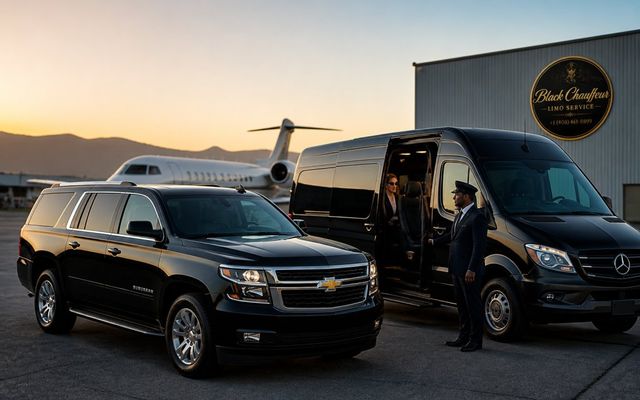
Your driver must be ready to depart immediately. A Chevrolet Suburban is ideal for private aviation pickups, it offers luxury and comfort without the logistical complexity of a stretch limousine.
For multi-city private aviation roadshows, ground transportation must be synchronized across all legs. Your transportation partner should manage all legs as a single coordinated roadshow, not as separate bookings.
Security and Confidentiality at Private Terminals
Private aviation attracts executives with confidentiality requirements. FBO facilities are more secure than commercial terminals, but ground transportation remains a vulnerability.
Your transportation partner should enforce confidentiality protocols: drivers do not discuss passengers, flight information, or destinations; do not photograph passengers or vehicles; do not share itinerary details; and vehicles have tinted windows. For sensitive roadshows, request a non-disclosure agreement (NDA).
Black Chauffeur Limo Service's Private Aviation & FBO Transfers coordinate with FBO facilities, monitor aircraft arrival times, and maintain confidentiality protocols. We work with Signature Aviation at SJC and SFO, Atlantic Aviation at SJC, and other regional FBOs.
Vehicle Selection for Private Aviation
A Chevrolet Suburban works well for private aviation pickups, it offers luxury, comfort, and room for luggage without the conspicuous length of a stretch limousine.
For one to three executives, a Lincoln Aviator provides a discreet option. For larger groups, a Mercedes-Benz Sprinter accommodates 7-14 passengers depending on configuration.
Your vehicle choice should account for passenger count, luggage volume, destination type, and FBO facility constraints.
Multi-City Private Aviation Roadshows
Multi-city private aviation roadshows require coordination with FBOs in each city, each with different procedures, notification systems, and pickup locations.
Your transportation partner should identify each FBO in advance, verify procedures and contacts, establish notification protocols, brief drivers on FBO-specific procedures, and maintain backup contacts at each facility.
Fleet Selection and Vehicle Capacity Planning
A Lincoln Aviator accommodates three passengers and three bags, discreet and suitable for high-level meetings.
A Chevrolet Suburban LT seats up to seven passengers and is ideal for airport transfers, hotel pickups, and point-to-point executive travel.
For groups of ten to fourteen people, a Mercedes-Benz Sprinter accommodates 6, 7-10, or 11-14 passengers and allows the entire group to travel together.
When passenger count changes between legs, vehicle selection may change. Your transportation partner should confirm passenger count for each leg and adjust vehicles accordingly.
Luggage planning matters as much as seating.
| Vehicle | Passengers | Luggage Space | Best For |
|---|---|---|---|
| Lincoln Aviator | 3 | 3 bags | Single executive or small group |
| Chevrolet Suburban | 7 | Ample | Small team, airport transfers |
| Mercedes Sprinter (6-10 config) | 7-10 | Spacious | Medium group, multi-stop roadshows |
| Mercedes Sprinter (11-14 config) | 11-14 | Most spacious | Large group, all-day coordination |
Booking and Contingency Planning
A roadshow lives or dies on contingency planning. Flights delay, meetings run long, drivers become unavailable, weather impacts traffic. Account for these scenarios or fail.
Real-Time Flight Monitoring
Buffer Time and Schedule Padding
Driver Unavailability and Backup Assignment
Vehicle Contingencies
Route and Venue Changes
Communication Protocol During the Roadshow
How can you plan your chauffeur transportation?
Review our Bay Area airport transportation service, compare chauffeured vehicle options, or check availability and request an exact price for your itinerary.
Frequently asked questions
- What is a corporate roadshow and why does it require specialized transportation?
- A corporate roadshow involves executives traveling to multiple locations over several days to meet investors, clients, or partners. Specialized transportation ensures consistent scheduling, professional presentation, and coordination across multiple stops. Pre-arranged chauffeur service eliminates delays, manages itinerary changes, and allows executives to focus on meetings rather than navigation. Unlike standard car services, roadshow transportation requires real-time flight monitoring, multi-vehicle coordination, and flexibility to adjust routes based on meeting schedules.
- How far in advance should I book corporate roadshow transportation?
- Book 12–24 hours before your roadshow begins to ensure the appropriate vehicles and professional chauffeurs are available. This lead time allows for detailed itinerary review, vehicle selection based on passenger count and luggage, and coordination of multiple pickups or stops. For complex roadshows involving multiple vehicles, airport transfers, and FBO pickups, earlier booking helps confirm availability and allows time to address any schedule changes or special requirements.
- How does multi-stop chauffeur service handle real-time itinerary changes?
- Professional chauffeur services monitor flights in real time and adjust pickup times accordingly. If a meeting runs late or a flight is delayed, you can contact your service provider to modify the next pickup. This flexibility is critical for roadshows where schedules shift frequently.
- What vehicle should I choose for a Silicon Valley executive roadshow?
- Vehicle selection depends on passenger count and luggage. A Chevrolet Suburban LT accommodates up to 7 passengers for point-to-point transfers and airport pickups. For larger groups or multiple simultaneous stops, a Mercedes-Benz Sprinter van accommodates 6–14 passengers depending on configuration. For smaller executive teams, a Lincoln Aviator works for up to 3 passengers. Consider whether you need one vehicle for the entire roadshow or multiple vehicles coordinating across different locations and meeting times.